

The short answer: if you want your store in Apple's App Store and on Google Play, use a dedicated Shopify app builder. Hulk has the lowest fixed monthly price, $79. Shopney ($149) is rated 5.0 from 771 reviews and does the store submission for you. Superfans (formerly Vajro) has the most reviews, Plobal can take 3% of app sales instead of a monthly fee, and Appbrew builds the app as you chat with its AI. Tapcart and Appmaker are made for big brands, from $500 and about $1,000 a month. GenVibe is the different option: you describe the app and AI builds a custom website and Android app on your store, with no fee per store or per app, but it can't publish to the iPhone App Store yet.
Every price, free trial and rating below is from each builder's Shopify App Store listing and, where it has one, its own pricing page, checked on October 27, 2026. The ratings are the Shopify App Store's, not ours. The eight Shopify apps are listed by how many reviews they have, most first. GenVibe, the builder behind this blog, isn't a Shopify app, so it comes last, and we say plainly where the others are ahead of it.
What a Shopify mobile app builder does
A Shopify mobile app builder turns your online store into a mobile app that shoppers download from Apple's App Store or Google Play. Most work the same way: you install the builder from the Shopify App Store, pick a template, and arrange your screens in a drag-and-drop editor, where you move ready-made blocks around instead of writing code. The app stays in sync with your store, so products, prices and stock match your Shopify admin.
A big reason stores want an app is push notifications: short messages that pop up on a shopper's phone, such as "Your size is back in stock" or "You left something in your bag". All eight Shopify apps below include them. To publish under your own brand you also need developer accounts: Apple charges $99 a year and Google Play $25 once.
There are two kinds of tool. Dedicated builders, the first eight below, are Shopify apps with templates and an editor, paid monthly. AI app builders such as GenVibe write a custom app from a description of what you want.
Shopify mobile app builders compared
| Builder | Starts at, monthly | Free plan or trial | Shopify App Store rating | iPhone and Android | Push notifications |
|---|---|---|---|---|---|
| Superfans (Vajro) | $150 ($1,000 on its own site) | 30-day trial | 4.9 (904 reviews) | Yes | Every plan |
| Shopney | $149 | 30-day trial | 5.0 (771) | Yes | Every plan |
| Tapcart | $500 | 7-day trial | 4.7 (339) | Yes | Every paid plan |
| MageNative | $99 | 30-day trial | 4.8 (338) | Yes | 5 a month on Starter |
| Plobal Apps | $0 + 3% of app sales | Free Starter; 30-day trial on paid plans | 4.8 (148) | Yes | From Starter |
| Appbrew | From $199 | 30-day trial | 5.0 (76) | Yes | Every plan |
| Hulk | $79 | 14-day trial | 4.7 (76) | Yes | 30 on Basic |
| Appmaker | About $1,000 + 0.5–1% of app sales | 14-day trial | 4.4 (31) | Yes | Yes |
| GenVibe | $12 for 100 credits | 20 free credits, once, no card | Not a Shopify app | Android and Google Play; iPhone testing only | No push dashboard |
Ratings and review counts are from the Shopify App Store on October 27, 2026. "Starts at" is the cheapest plan for a live store, billed monthly.
1. Superfans (formerly Vajro): the most reviewed, with live selling
Superfans is the new name of Vajro, and it says it has helped more than 5,000 merchants build apps over the last decade. It builds native iOS and Android apps with a drag-and-drop builder, and you can host live video selling sessions in your app and on Facebook.
- Good: rated 4.9 from 904 reviews, the most of any builder here. Push notifications, app-only discounts and product drops, in-app chat and 24/7 support are on the first plan, and its help center says your app goes on both Google Play and the App Store.
- Watch out: the prices don't match. The Shopify App Store shows a $150 Starter plan, but Superfans' own pricing page lists a single plan at $1,000 a month. Ask which one you'll get before you start.
Price: Starter $150 a month; the full plan $1,000 a month or $10,000 a year. 30-day free trial. Superfans' own site says it takes no share of your sales.
2. Shopney: best for a hands-off launch
Shopney turns your store into iOS and Android apps with a drag-and-drop design editor and layout choices for product and collection pages. Its help center says "We handle the entire app submission process": you create the Apple and Google developer accounts, give Shopney access, and its team submits the app.
- Good: rated 5.0 from 771 reviews. Push notifications, back-in-stock alerts, in-app chat and Google Analytics are on the first plan, every plan includes onboarding help, and Shopney says it takes no commission on your sales.
- Watch out: abandoned-cart notifications start on Gold ($299), and segmented and AI push notifications on Platinum ($599).
Price: Silver $149, Gold $299, Platinum $599 and Enterprise from $1,299 a month. Billed yearly, they are $119, $239, $499 and $999 a month. 30-day free trial.
3. Tapcart: best for established brands
Tapcart is built for brands with a marketing team. Its App Studio lets that team change the app's design and content without a developer, and its AI personalizes campaigns, recommendations and shopping journeys based on what each shopper does.
- Good: rated 4.7 from 339 reviews. Every paid plan has push notifications, 24/7 support and a managed Apple and Google developer portal. Scale adds A/B testing (showing shoppers two versions to see which sells more) and advanced analytics, and Enterprise+ adds a 99.99% uptime promise and SOC 2, a security audit large companies ask for.
- Watch out: the price. Growth is $500 a month, the AI add-on is $250 a month more, and the free trial lasts 7 days. Tapcart also says an App Store launch needs a registered company and a D-U-N-S number (a business ID from Dun & Bradstreet).
Price: Growth $500, Scale $1,250 and Enterprise+ $2,850 a month.
4. MageNative: best for stores that sell worldwide
MageNative builds native Android and iOS apps with a drag-and-drop builder and ready-made themes. Its listing highlights selling worldwide, with several languages and currencies and support for right-to-left languages such as Arabic, and it says it can move your app from another builder with no data loss or downtime.
- Good: rated 4.8 from 338 reviews, with a 30-day free trial. App-only discounts and a live video selling integration are on the first plan. Premium adds AR (augmented reality, so shoppers can see a product in a real setting) and advanced app analytics, and removes the push notification limit.
- Watch out: Starter includes only 5 push notifications a month and Standard 50, and several languages and currencies start on Standard ($149).
Price: Starter $99, Standard $149 and Premium $249 a month, with 10% to 15% off billed yearly.
5. Plobal Apps: best for paying only when the app sells
Plobal builds native iOS and Android apps with a drag-and-drop builder. Its Starter plan has no monthly fee: you pay 3% of the sales made in the app, and only once the app is live.
- Good: rated 4.8 from 148 reviews. Push notifications and real-time analytics are on Starter, and Essential adds Apple Pay, notifications aimed at groups of shoppers and a dedicated success manager.
- Watch out: 3% grows with your sales. Once the app sells about $6,600 a month, the fee matches the $199 Growth plan, and above that Growth is cheaper. Enterprise also takes 1% of app sales on top of its monthly price.
Price: Starter free plus 3% of in-app sales; Growth $199, Essential $499 and Enterprise $1,199 a month, 17% less billed yearly. 30-day free trial on the paid plans.
6. Appbrew: best for building the app by chatting with AI
Appbrew is the closest of the eight to an AI builder. Its AI assistant, Milo, builds and runs the app with you: ask for a new screen, a campaign or a push notification, and it drafts it, shows you the plan and waits for your yes. There's a visual editor if you prefer, and Appbrew's team submits the app to the App Store and Google Play.
- Good: rated 5.0 from 76 reviews. Push notifications, search, wishlists and conversion analytics are on Starter. You own your Apple and Google accounts, so the app listing, reviews and analytics stay yours.
- Watch out: Starter "starts at" $199 with "additional charges based on app performance", so ask what you'll pay as the app grows. Milo's use is capped at 500 AI credits a month on Starter.
Price: Starter from $199, Pro from $599 and Enterprise from $1,099 a month. 30-day free trial on Starter.
7. Hulk Mobile App Builder: best for the lowest fixed monthly price
Hulk, from HulkApps, has the lowest fixed monthly price of the eight and is the only one with Shopify's "Built for Shopify" badge, which Shopify gives apps that meet its highest standards for performance, design and integration. It builds native iOS and Android apps with templates, a drag-and-drop page builder and a live preview, and it can also sell to business customers (B2B).
- Good: rated 4.7 from 76 reviews, with a 14-day free trial. Hulk says its specialists handle the App Store and Google Play submission, and that most apps can be built and submitted to both stores within 7 business days.
- Watch out: Basic includes up to 30 push notifications; Pro ($149) removes the limit and adds scheduled notifications and advanced reporting. The free plan is only for Shopify partner development stores, which are test stores, not live shops.
Price: Basic $79, Pro $149 and Pro+ $249 a month, 17% less billed yearly. Hulk's own site also lists Enterprise at $399.
8. Appmaker: best for a fully custom app
Appmaker is for brands that don't want a template look. Appmaker Studio is a drag-and-drop builder with a live preview, its AI assistant, John, helps with analytics and campaigns, and the top plan gives your developers full access to build custom features.
- Good: native iOS and Android apps, push notifications and Firebase analytics, with custom integrations and developer access on the top plan.
- Watch out: the highest starting price here, a share of your app sales on top, and the fewest reviews: 4.4 from 31.
Price: about $1,000 a month plus a share of app sales. The Shopify App Store listing shows Pro at $1,000 a month plus 1% of in-app sales ($9,000 billed yearly), while Appmaker's own pricing page shows Growth at $999 plus 0.5%. The top plan starts at $2,000. 14-day free trial.
9. GenVibe: best for a custom website and Android app from one description
GenVibe is a different kind of tool: an AI app builder, not a Shopify app. You connect your store, describe the app you want in plain words, and the AI writes it with your real products: a product list with collections and search, product pages with variants such as sizes and colours, a cart that remembers what's in it, and checkout on Shopify's own secure page. The same app can be a website, a mobile app, or both.
How you connect your store. In GenVibe, open Customize → Connectors, choose Shopify and paste three values: your store's myshopify.com address, and the Client ID and Client secret of a small app you create for your store in Shopify's Dev Dashboard, where you make apps for your own store. The form lists every click. If you already have an older custom app, you can paste its access tokens instead.
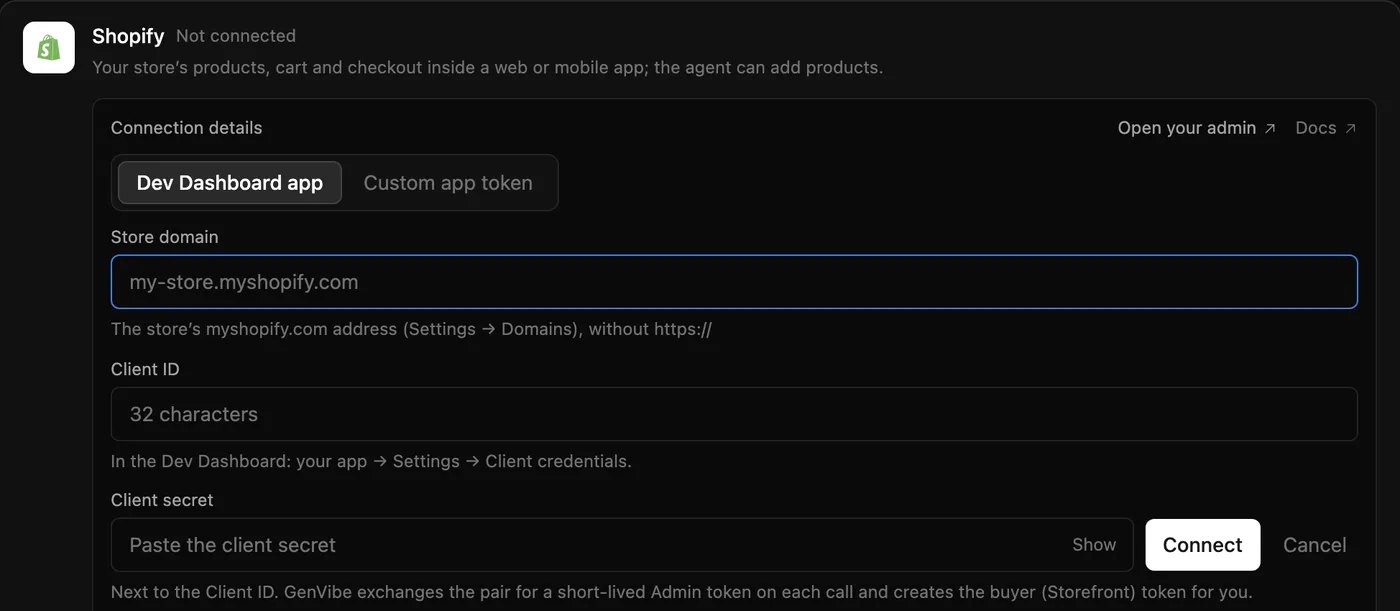
Your store's keys are stored encrypted on GenVibe's servers and never go into your app's code. The app talks to your store through GenVibe, so it works as a published website and as a mobile app without a server of your own. When you ask, the AI can also add products and collections to your store. It can't change orders, customers or refunds; those stay in your Shopify admin.
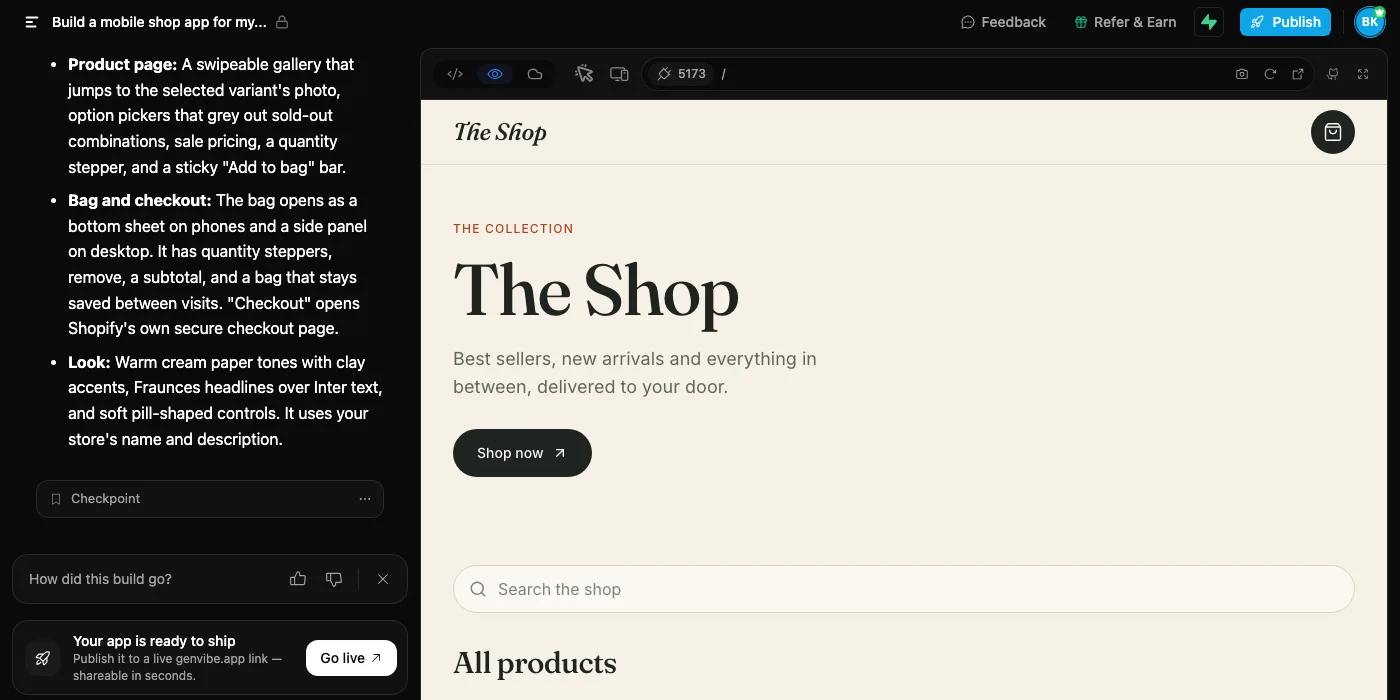
The mobile app. GenVibe builds mobile apps with React Native and Expo, a common way to make one app that runs on both Android and iPhone. While it builds, you can open the app on your own phone, Android or iPhone, with the free Expo Go app. GenVibe then builds the installable Android app on your own Expo account, free on every plan. On a paid plan or with any credit pack, it uploads the app to your Google Play account for testing and drafts the store listing; the Google Play guide covers the steps Google still asks of you. GenVibe can't publish to Apple's App Store yet.
- Good: a design made for your shop from a description, not a template; a website and a mobile app from one place; no fee per store or per app; and the code is yours, with Push to GitHub on every plan.
- Watch out: no iPhone App Store publishing yet, no push notification dashboard and no built-in analytics for published apps. Connecting also takes more steps than installing a Shopify app.
Price: 20 free credits, once, with no card. Plans start at $12 a month for 100 credits ($9 the first month), or you can buy 50 credits for $5 without a subscription. Credits pay for the AI's work when it builds or changes your app. Publishing to a free genvibe.app link is included, and your own domain needs a paid plan. See pricing.
What dedicated Shopify app builders do better
GenVibe makes this blog, so here is where the eight Shopify apps above are ahead of it today:
- Both app stores. All eight publish to Apple's App Store and Google Play. Shopney, Appbrew and Hulk say their own team does the submission, and Tapcart manages your Apple and Google developer portal. GenVibe publishes to Google Play only for now.
- Push notifications. All eight include them, and all eight offer abandoned-cart reminders, though some only on higher plans. GenVibe has no push notification dashboard.
- Analytics. Plobal and Appbrew include app analytics on their first plan, Shopney connects Google Analytics from Silver, Hulk adds advanced reporting on Pro, and Tapcart advanced analytics on Scale. GenVibe has no built-in analytics for published apps.
- Installed from the Shopify App Store. You add them to your store in a few clicks, they stay in sync with it, and the subscription usually goes on your Shopify bill. With GenVibe you create an app in Shopify's Dev Dashboard and paste its Client ID and secret.
- People to help. They come with support teams, and the bigger plans add a dedicated success manager. GenVibe is run by its founder, who answers support himself.
- Big traffic. Tapcart's Enterprise+ plan promises 99.99% uptime in writing. GenVibe has no published uptime promise and hasn't yet been proven on big-sale traffic.
Where GenVibe is different: it designs the app for your shop instead of filling in a template, it builds the website as well as the mobile app, the code is yours, and there's no monthly fee per app. If you need the iPhone App Store or push campaigns today, choose one of the eight above.
What a Shopify mobile app costs for a year
Monthly prices hide the real cost, so here is a year on each builder's first plan for a live store, billed yearly where the builder lists a yearly price:
| Builder | First plan | A year |
|---|---|---|
| Hulk | Basic | $790 |
| MageNative | Starter | $1,069 |
| Shopney | Silver | $1,428 |
| Superfans | Starter | $1,800 |
| Plobal Apps | Starter, or Growth | 3% of app sales, or $1,990 |
| Appbrew | Starter | From $2,388, plus charges based on app performance |
| Tapcart | Growth | $6,000 |
| Appmaker | Pro | $9,000 plus 1% of app sales |
| GenVibe | Free to start | No yearly app fee; you pay for credits as you build |
Add Apple's $99 a year and Google Play's $25 once for the developer accounts. With GenVibe there's no Apple fee for now, because it doesn't publish there yet; publishing to Google Play needs a paid plan or any credit pack, and your own domain needs a paid plan.
How to choose a Shopify mobile app builder
- Do you need the iPhone App Store now? If yes, pick one of the eight Shopify apps. GenVibe publishes to Google Play only for now.
- Price the whole year. Use the table above, and add your developer accounts.
- Check for a share of your sales. Plobal takes 3% of app sales on Starter and 1% on Enterprise, Appmaker 0.5% to 1%, and Appbrew lists extra charges based on app performance. Shopney says it takes no commission, MageNative lists a 0% success fee, and Superfans' own site says it charges no success fee.
- Check the push limit on the cheapest plan. MageNative's Starter allows 5 a month, about one a week, and Hulk's Basic 30.
- Get your developer accounts before the trial. Shopney says Apple and Google accounts usually take 2 to 7 days. Trials last 7 days on Tapcart, 14 on Hulk and Appmaker and 30 on the rest, so spend them on the app, not on paperwork.
- Want a custom design or a website too? Then try an AI builder such as GenVibe, which builds both from your store.
Want to see what GenVibe makes from your store first? Try it free with 20 credits →
Frequently asked questions
What is the best Shopify mobile app builder?
It depends on your budget and how much you want done for you. On October 27, 2026, Superfans (formerly Vajro) had the most Shopify App Store reviews (904, rated 4.9) and Shopney the next most (771, rated 5.0). Hulk has the lowest fixed monthly price at $79, Plobal’s Starter plan takes 3% of app sales instead of a monthly fee, Appbrew builds the app as you chat with its AI, and Tapcart and Appmaker are made for big brands. GenVibe builds a custom website and Android app on your store with AI, but it can’t publish to the iPhone App Store yet.
Is there a free Shopify mobile app builder?
Not among the dedicated builders. Plobal’s Starter plan has no monthly fee but takes 3% of the sales made in the app once it’s live, and Hulk’s free plan is only for Shopify development stores. The others have free trials of 7 to 30 days. GenVibe gives 20 free credits, once, with no card, and publishing the website version to a genvibe.app link is free; Google Play publishing needs a paid plan or any credit pack.
How much does it cost to turn a Shopify store into a mobile app?
On these builders, monthly plans run from $79 (Hulk Basic) to $2,850 (Tapcart Enterprise+), or about $790 to $9,000 for a year on the first plan. Plobal’s Starter takes 3% of app sales instead of a monthly fee, and Appmaker adds 0.5% to 1% of app sales to its plans. Publishing also needs an Apple developer account at $99 a year and a Google Play account at $25 once.
Do I need my own Apple and Google developer accounts?
Yes. To publish under your own brand you need an Apple Developer account ($99 a year) and a Google Play developer account ($25 once). Builders such as Shopney and Appbrew then publish through your accounts, so the app listing stays yours. Tapcart says an App Store launch also needs a registered company and a D-U-N-S number, a business ID from Dun & Bradstreet.
Can GenVibe publish my Shopify app to the iPhone App Store?
Not yet. GenVibe builds the Android app on your own Expo account and, on a paid plan or with any credit pack, uploads it to your Google Play account. You can try the app on an iPhone with the free Expo Go app while you build, but GenVibe can’t publish to Apple’s App Store yet.
Can GenVibe’s AI change my Shopify orders or customers?
No. When you ask, it can add products and collections to your store, but it can’t change orders, customers or refunds; those stay in your Shopify admin. Your store’s keys are stored encrypted on GenVibe’s servers and never go into your app’s code.
Sources, checked October 27, 2026: the Shopify App Store listings for Superfans (formerly Vajro), Shopney, Tapcart, MageNative, Plobal Apps, Appbrew, Hulk Mobile App Builder and Appmaker, and the pricing pages of Superfans, Shopney, Tapcart, MageNative, Appbrew, Hulk and Appmaker. Prices and ratings change; check each listing for the latest.