
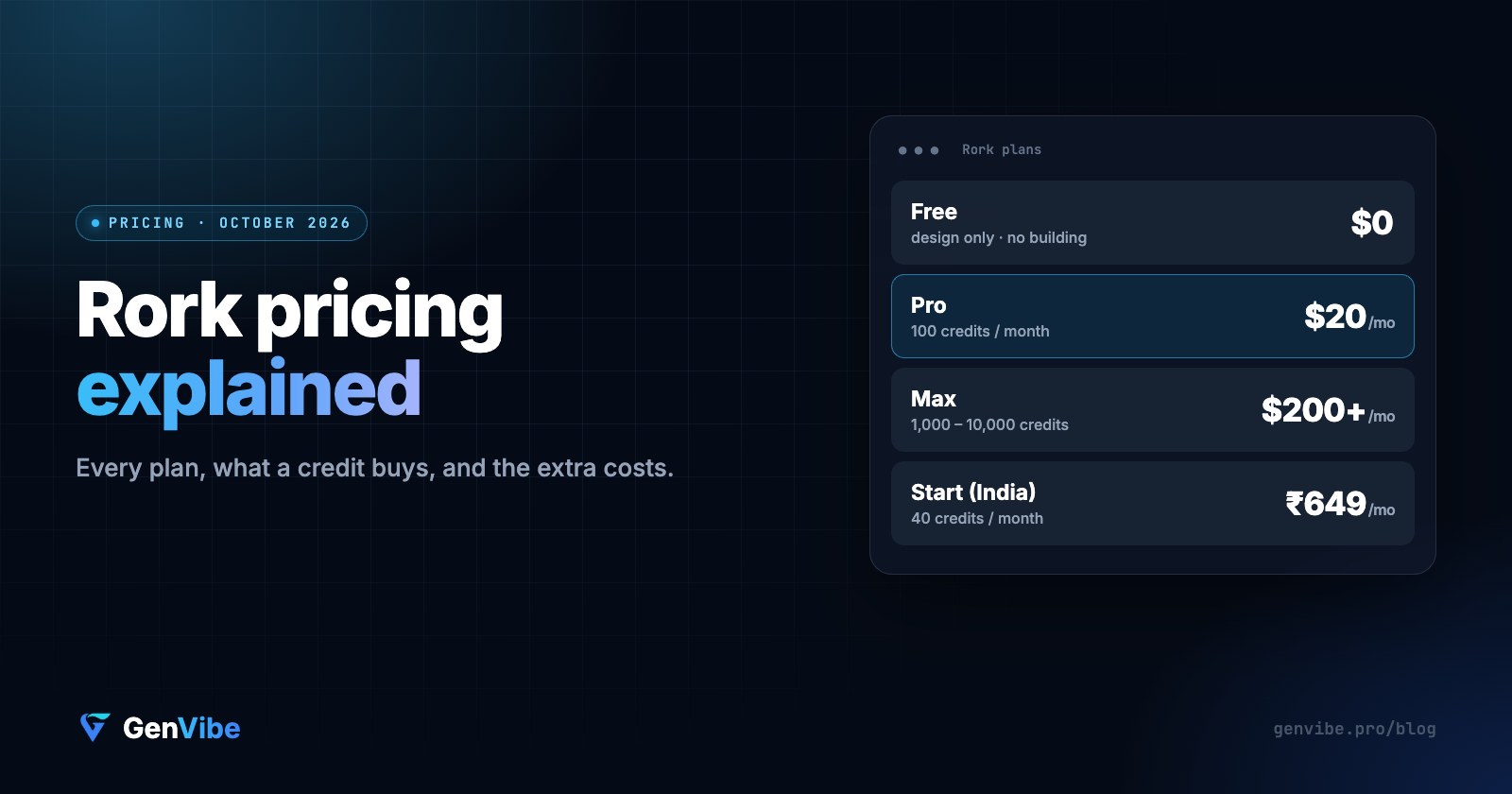
The short answer: Rork's free plan only designs your app. To build a working app you need Rork Pro at $20/month (100 credits). Heavy users can move to Rork Max, from $200/month for 1,000 credits up to $1,800/month for 10,000. On top of your plan, iOS builds and cloud simulator time cost extra credits, and AI features inside your app use a separate balance.
Everything below is from Rork's own documentation, checked in October 2026.
Rork plans and prices at a glance
| Plan | Price | Credits / month | Can build apps? |
|---|---|---|---|
| Free | $0 | 35 (major markets), 5 elsewhere; max 5/day | No, design only |
| Start (India only) | ₹649/mo | 40 | Yes |
| Pro | $20/mo | 100 | Yes: iPhone, Android, web |
| Max | $200 / $500 / $900 / $1,800 per month | 1,000 / 2,500 / 5,000 / 10,000 | Yes, plus iPad, Apple Watch, Vision Pro |
What each paid plan adds:
- Pro: Build mode, native iPhone apps (SwiftUI), native Android apps (Kotlin), web apps, and Dev mode to edit the code yourself.
- Max: everything in Pro, plus iPad, Apple Watch and Vision Pro apps, native games, iOS widgets and priority support.
Is Rork free?
Only for designing. On the free plan Rork asks a few questions and draws your screens, but pressing Build asks you to pick a plan. As Rork's docs put it, free credits cover design, and building your app needs a plan. You can read the generated code on any plan, but editing it by hand also needs a paid plan.
So the honest answer to "is Rork free?" is: free to design, $20/month to build.
How Rork credits work
- One credit ≈ one request where Rork designs, builds or edits your app.
- No daily cap on paid plans. The free plan is limited to 5 credits a day.
- Monthly reset. Paid plans reset on the anniversary of your first purchase; the free plan resets at the start of each calendar month. When you run out, you upgrade or wait.
- Some actions cost more. iOS builds and cloud simulator sessions run on real machines, so they are charged on top of the message that started them.
- Two balances. Build credits pay for the agent building your app. AI and cloud features that your finished app uses run on a separate Cloud credit balance.
What a Rork credit costs
| Plan | Monthly price | Per credit |
|---|---|---|
| Pro | $20 | $0.20 |
| Max 1,000 | $200 | $0.20 |
| Max 2,500 | $500 | $0.20 |
| Max 10,000 | $1,800 | $0.18 |
Bigger plans barely lower the price per credit. Max is worth it for the extra Apple devices and games, not for cheaper credits.
The big change: Rork no longer builds React Native
Rork used to build Expo (React Native) apps. It has switched: in its own words, "Internal benchmarks showed the agent writes better Swift apps, so we switched." New iPhone apps are Swift, new Android apps are Kotlin, and you can no longer start a new Expo project. Existing Expo projects keep working.
That matters for your budget. An iPhone app and an Android app are now two separate codebases in Rork, and the agent has to keep them in sync. With React Native, one codebase runs on both.
Costs outside Rork
- Apple Developer Program: $99/year to publish on the App Store.
- Google Play: a one-time $25 registration fee.
These apply to every app builder, not just Rork.
Which Rork plan should you choose?
- Free to see what your app could look like before paying.
- Pro for a first real app on iPhone, Android or web. 100 credits suits a focused first app.
- Max if you need iPad, Apple Watch or Vision Pro, games or widgets, or you build all day.
A cheaper option for React Native: GenVibe
If you want one codebase for iPhone and Android, or you want to build without paying first, GenVibe is the closer fit:
| Rork | GenVibe | |
|---|---|---|
| Free plan | Design only | 20 credits that build a working app |
| Entry paid plan | $20/mo, 100 credits | $12/mo, 100 credits ($9 first month) |
| Mobile apps | Two native codebases (Swift + Kotlin) | One React Native (Expo) codebase |
| Web apps | Yes | Yes |
| Your code | GitHub sync | Download or push to GitHub |
Credits aren't the same unit across tools, so compare what you get rather than the raw numbers. If native Swift for every Apple device is what you need, Rork Max is built for that. If you want a React Native app for both stores on a smaller budget, try GenVibe free → or see the full Rork vs GenVibe comparison.
Frequently asked questions
How much does Rork cost?
Rork has a free plan, Rork Pro at $20/month for 100 credits, and Rork Max from $200/month (1,000 credits) up to $1,800/month (10,000 credits). In India there is also Rork Start at ₹649/month for 40 credits.
Is Rork free?
Only for designing. The free plan runs in Design mode: Rork draws your screens, but turning them into a working app (Build mode) needs a paid plan. Free users get 5 design credits a day, up to 35 a month in major markets and 5 a month elsewhere.
What is a Rork credit?
A credit is roughly one request where Rork designs, builds or edits your app. Some actions cost extra: iOS builds and cloud simulator sessions are charged on top of the message that started them, and AI and cloud features inside your finished app use a separate Cloud credit balance.
Does Rork still build React Native apps?
No. Rork switched to native Swift for iPhone and Kotlin for Android, and new projects can no longer use Expo (React Native). Existing Expo projects keep working.
What is a cheaper alternative to Rork?
GenVibe builds React Native (Expo) apps and web apps from a prompt, a Figma design or a screenshot. Its free plan builds a working app, not just designs, and paid plans start at $12/month ($9 for the first month).
Sources: Rork plans & subscriptions, Build credits vs Cloud credits and What happened to Expo?, checked October 7, 2026. Prices change; check Rork's site for the latest.